El artificio de la escritura / The artifice of writing


domingo 7 de febrero de 2010

Garabatear ::::: Doodling

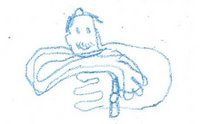
Como el niño que descubre maravillado la línea que la crayola marca en la pared hasta ese instante en blanco--o de un mate gris perla o un verde agua--y no puede ya dejar de rayarlo todo, así los mayores que sufren la tortura de largas reuniones e interminables peroratas se entretienen, fascinados de su magia, con las líneas que el lápiz ocioso en la mano dibuja en el papel dispuesto a las notas que se esperó tomar y no hay quien tome. La mano que se aburre, actúa por si sola: el garabato se va desarrollando solo, como un signo secreto, indescifrable, de lo inane: ojo de la cerradura de un portón que ha de abrirse a lo otro, a lo que se ha querido siempre sin saber bien en qué consiste. La línea del garabato, la marca del lápiz en el papel, va cerrando el símbolo espontáneo de lo que no se sabe pero se imagina y se desea. Garabato de la impaciencia controlada, línea del nervio enroscado sobre sí mismo, cola enredada del dragón: figura caprichosa del hastío que se sobrelleva apenas.

sábado 6 de febrero de 2010

Dos en uno +++ Two in One

Una cosa es lo que uno dice y escribe y otra lo que uno hace. Son dos mundos diferentes el de la acción y el de la palabra; o podría decirse que hay dos personas en uno mismo: la que se sienta al escritorio, enciende el computador y teclea; y la que le dicta a ésta lo que escriba. En este momento soy esas dos personas un tanto contradictorias.


One thing is what one says and writes, and quite another what one writes. The world of action and the world of writing are two different worlds; or one could say that there are two persons in oneself: the one who sits at the desk, turns on the computer and types; and the one who dictates what the other types. At this moment I am both, slightly contradictotry, persons.

miércoles 3 de febrero de 2010

El don de la escritura ooo The Writer's Gift

El arte de la escritura es en algunos un don; en otros --la vasta mayoría--un imposible. El artificio de escribir ya es otra cosa, porque son infinidad los prestidigitadores de la palabra: cuasi artistas de circo y vaudeville. Vaudeville y circo de la literatura al día, qué digo: al momento.

The art of writing is for some people a gift; for others --the vast majority of people-- it is an impossibility. The artifice of writing, though, is quite another thing. They are too many the word trickers, almost artists of the circus and the vaudeville. Vaudeville and circus of the literature of the day--what am I saying?--of the moment.

sábado 9 de enero de 2010

Un texto de Luis Oyarzun

No hay cosa más difícil que la aceptación lisa y llana de la vida--escribe Luis Oyarzun en su Diario el 21 de febrero de 1964--. Algo en el hombre está fuera de toda realidad y es incongruente. Algo de lo humano representa un anti-humano, y lo exige. La cultura es también ese esfuerzo inveterado por humanizar un mundo que no es humanizable, transformando a la tierra en paisaje. Es decir, convirtiendo mentalmente, por la fantasía, a ese terrón inhóspito, a ese caparazón mineral desnudo de espíritu, como la luna, en espejo del alma.

There is nothing more difficult than to accept life as it is--Luis Oyarzun writes in his Journal on February 21, 1964. Something in man is outside of all reality and it is incongruous. Something in human nature represents the anti-human, and demands it. Culture is also this obstinate effort to humanize, by transforming the earth into a landscape, a world that cannot be humanized. In other words, to transform it by mentally changing, through fantasy, this inhospitable glebe, this mineral crust bereft of spirit, like the moon, in the soul's mirror.
Photo by Eduardo Jiménez

lunes 9 de noviembre de 2009

Two lines = Dos versos


“A life poured into words—apparent waste
Intended to preserve the thing consumed.”

Two verses of the poem “The Author Observes His Birthday, 2005”, by John Updike, from his book, Endpoint and Other Poems, Knopf, 2009, p. 8.


“Una vida derramada en palabras—evidente desperdicio
En el intento de preservar lo consumido”.

Dos versos del poema “El autor celebra su cumpleaños, 2005”, del libro Punto final y otros poemas, 2009, de John Updike.

domingo 1 de noviembre de 2009

Otoño ::: Fall


Otoño es, yo diría, el mejor período del año. Días como hoy, este primer domingo de noviembre, lo convencen a uno de la excelencia de esta estación. Algo hay en su lento avanzar hacia el invierno que nos afecta de un modo inexpresable, algo que conmueve y tranquiliza. Algo que a la vez nos exalta y nos calma. Nuestro sistema se trastorna al extremo de alcanzar, sin saber cómo ni por qué, los estados más intensos de lo espiritual. Se diría que tiene esta luz de noviembre un fulgor de trascendencia, que la quietud del aire tiene el vibrar profundo de lo numinoso y que las cosas participan de un estar contemplativo.

Y todo esto por que el eje de la tierra se ha inclinado una vez más según un ritmo y una ley que pensamos inviolables. Año a año vuelve el otoño y siempre el mismo de otras veces. Contamos con su vuelta y lo recibimos y aceptamos como un bien indisputable, un derecho y un don que nos otorga nuestro estar en el tiempo. Ese mismo tiempo que nos dice que aunque siga el orbe en su girar interminable, para cada uno de nosotros habrá un último otoño, el impredecible otoño de nuestra última exaltada ilusión de lo trascendente.


: : : : : : : : :


Fall is, I would say, the best time of the year. Days like today, this first Sunday of November, convince us of the season’s excellence. There is something in its slow movement towards winter that affects us in a way we cannot express, something that trouble us and gives us peace. Something that at the same time calms us and exalts us. Our system is transformed to the extreme of reaching, not knowing how and why, the most intense states of spirituality. One would say that this November light has the brightness of transcendence, that the quiet air has the deep tremor of the numinous, and that things are participant of a state of contemplation.
And all of this because the earth’s axle has tilted once more following a rhythm and a law we think inviolable. Year after year fall returns, and it is always the same of before. We count on its return, and we receive it and accept it as an indisputable good, as a right and a present we are given because we are in time. That same time that tells us that even if the orb continues in its never ending gyration there will be for each one of us a last fall, the unpredictable fall of our last exalted illusion of transcendence.